Reviews: The 1990s on Vinylphyle

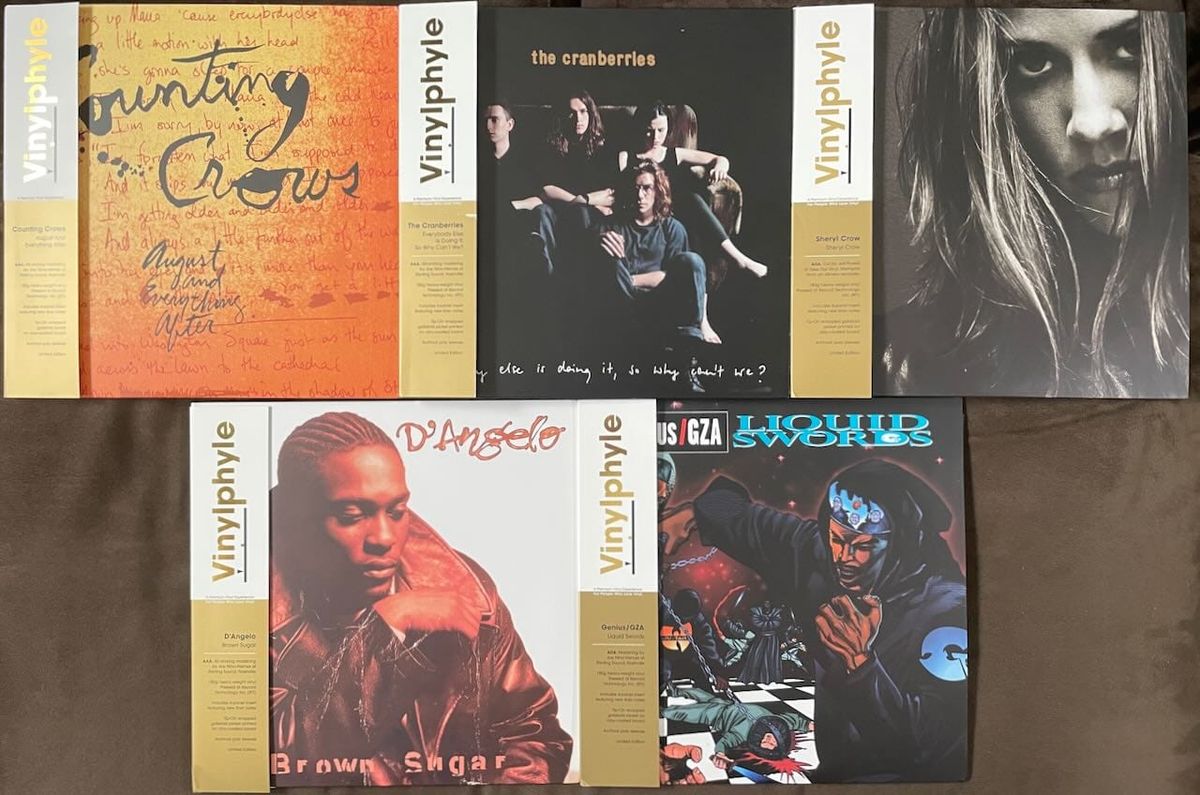
New reissues from Counting Crows, the Cranberries, Sheryl Crow, D’Angelo, and GZA.
It’s been a little bit since I checked in on UMe’s Vinylphyle series. Launched in November of last year, the imprint has produced well-regarded vinyl reissues of milestone albums in the Universal Music Group catalog, including The Velvet Underground and Nico, Pet Sounds, and Frampton Comes Alive! (Read our previous Vinylphyle reviews here, here, here, here, here, and here.) But the series has quickly revealed itself to be more wide-ranging than your typical audiophile-oriented reissue line, not just rehashing the expected classic-rock monoliths from the ’60s and ’70s but also selecting albums that draw from the alt-rock, hip-hop, and neo-soul scenes of the 1990s. Today I’m reviewing five of the ’90s reissues that have appeared as Vinylphyles in the past few months.
- Counting Crows: August and Everything After
- The Cranberries: Everybody Else Is Doing It, So Why Can’t We?
- Sheryl Crow: Sheryl Crow
- D’Angelo: Brown Sugar
- Genius/GZA: Liquid Swords
This was the CD era, of course, and while most of these albums eventually got a vinyl release, the Vinylphyle of Sheryl Crow is actually the first time that album—a huge seller in 1996—has ever been released on vinyl. All of the albums except the Cranberries bear another symptom of the CD era: extended running times, with durations between 50 and 60 minutes. That means their Vinylphyle incarnations are stretched out to two LPs, often with sides as short as 11 or 12 minutes. (The Cranberries is a single LP.) All of the Vinylphyles are pressed at 33 RPM, so there are no 45 RPM versions, although most of the albums would have fit nicely within that format. Fortunately, they are all exceptionally well-mastered and well-pressed, so I don’t think anyone will be complaining about the fidelity.
Speaking of mastering, Vinylphyle’s primary selling point is that these discs are almost always all-analog when the source itself was recorded in analog, but there have been more than a few digital releases in the series by now. Mastering is generally handled by Joe Nino-Hernes at Sterling Sound, who has done an absolutely phenomenal job thus far, although some titles have been cut by other engineers, with similarly great results (for instance, Jeff Powell at Take Out Vinyl cut the Sheryl Crow record). Plating and pressing is done at Record Technology, Inc. (RTI) and is consistently good.
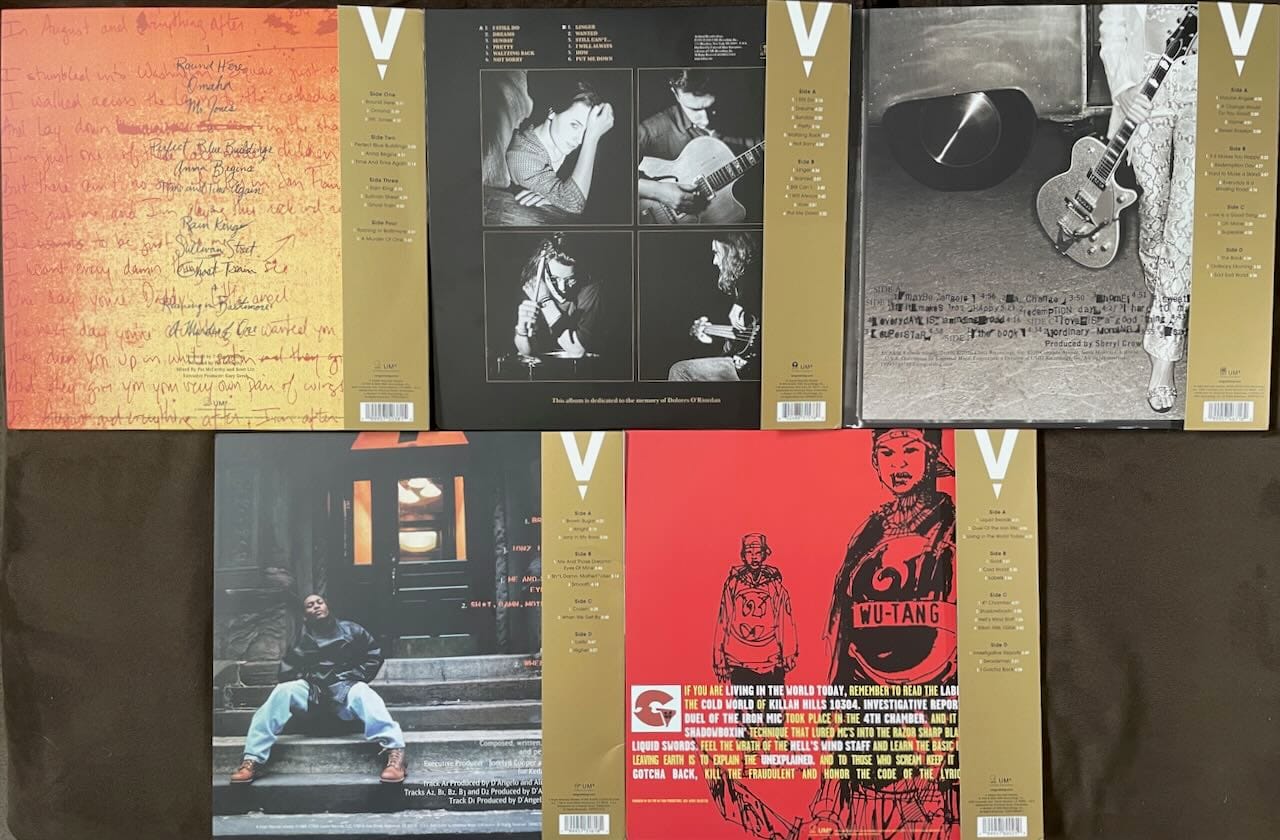
The jackets are tip-on gatefolds with handsome print jobs; the quality has generally been superb although some people have complained of seam splits resulting from shipping. That hasn’t been a problem with any of mine, but be aware. Vinylphyles also come with inserts that include images of the master tapes and liner notes. Some of these liners are better than others, but as someone trying to make a living out of writing about music, I always have to applaud the inclusion of an essay, not merely for the potential info it can impart to the listener but also because it means the record label deigned to send a check to a writer trying to make a living—always a good thing. All except one of the essays in today’s batch are worth reading, fortunately.
You may notice that there are a couple of recent, non-’90s Vinylphyle releases that I’m not including in today’s roundup—specifically, the Band’s Music from Big Pink and the Allman Brothers Band’s Live at Fillmore. Those have gotten exceptional marks from the vinyl community and I hope to have my own reviews ready for them soon. They will require a bit more space and time because of the larger number of older pressings that they can be compared to, their historical importance, and my own personal interest level. Stay tuned.
And before we dive into today’s ’90s roundup, some additional Vinylphyles are on the horizon: Bee Gees’ Children of the World comes out later this week, and since Vinylphyles often come in pairs, I wonder if another one will get announced in the next day or two. (If so, I’ll have details in tomorrow’s New Vinyl Reissues post.) And in October, we’re getting Sublime’s self-titled album and Frank Sinatra’s Sinatra at the Sands—a pretty divergent pair, I have to say. Those are both due out on October 23. All Vinylphyles are still only available online via a direct-to-consumer model; the easiest way to get them is through uDiscover Music, one of Universal Music’s many online storefronts. I’m hoping that one day they will be made available to brick-and-mortar record stores, but that hasn’t happened yet.
Counting Crows: August and Everything After
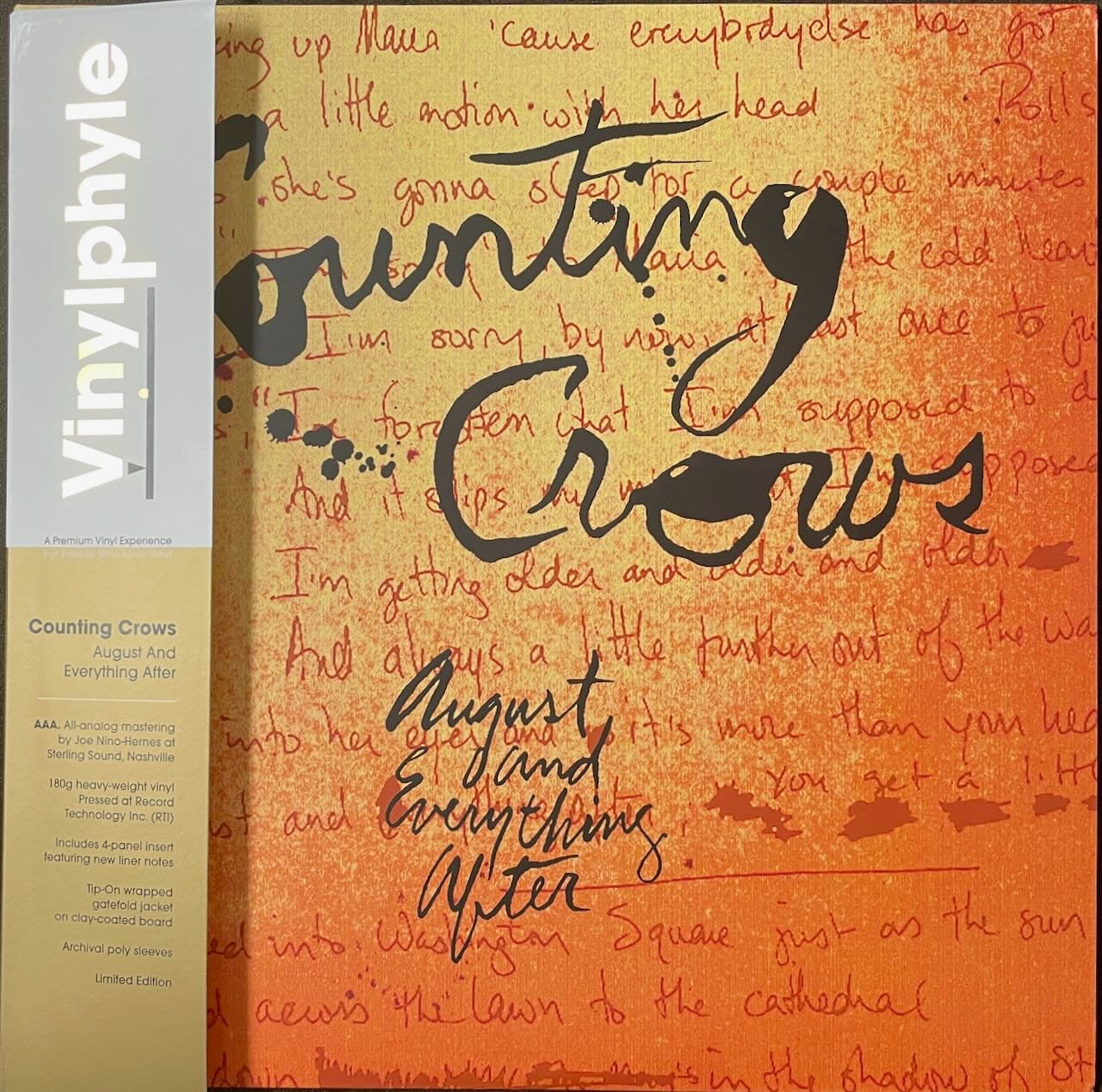
When the time came for Bay Area band Counting Crows to record their debut album, they rented a big house in Los Angeles and set up a studio inside. The gesture was apparently inspired by the Band’s debut Music from Big Pink, which of course was not actually recorded at Big Pink itself, but the mythology was always more important than the reality. (Per the liner notes in the new Vinylphyle edition, Robbie Robertson gave the band the idea, but he may have been remembering the Band’s second self-titled album, which was recorded in Sammy Davis Jr.’s pool house.) The move from San Francisco to the capital of the entertainment industry indicated perhaps another bit of mythologizing: Counting Crows, fueled by the songwriting of frontman Adam Duritz, were aiming squarely at the big time, hell-bent on busting out of the regional Northern California music scene and onto the world at large.
Mythology was baked into August and Everything After’s songs, too. The big hit, “Mr. Jones,” contains the almost embarrassingly revealing line, “I want to be Bob Dylan,” which basically gives the entire game away. And “Rain King” contains a literary reference to Saul Bellow’s Henderson the Rain King, a book about accidental cultural imperialism that Duritz has said encapsulates his views on the necessary irresponsibilities of pure creativity. The album cover is not a photo of the band or a representative piece of artwork, but instead is an image of a manuscript, with emphasis on the written word. Rather than depict any of the stories or moods within Duritz’s lyrics, the album cover draws attention to the very process of lyric-writing itself. Duritz—and by association, the rest of the band—were making Art with a capital A, and that fact was more important than what any of the individual songs had to say.
Upon its release in 1993, the acoustic strums and accordions of August and Everything After were a slight aberration from trends of fuzz-pedal-laden grunge and sample-strewn hip-hop, but rave reviews in places like Rolling Stone were quick to draw ties from Counting Crows to earlier musicians like Van Morrison, Bruce Springsteen, and the aforementioned Dylan and the Band. And yet, listening to the album more than 30 years later, what strikes me is not how retro the album sounds but how prescient it is. While not necessarily providing connect-the-dots blueprints for the coming trends in emo, alt-country, or indie-folk, August and Everything After’s attitude of self-consciously expressive and emotional songwriting as not just a compulsion but a higher calling has permeated a huge swath of music-making during the 21st century. The gregarious melancholy of Adam Duritz—and not the band’s orthodox folk-rock—is Counting Crows’ lasting legacy.
The album is an impressive debut by any measure but to me it falls short of being a classic. There are a couple too many downbeat dirges; August certainly would have thrived if it had been trimmed of “Time and Time Again” and the tedious “Ghost Train” and had the catchy outtake (and later radio hit) “Einstein on the Beach” added in to offer an upbeat contrast to second half’s chain of plodding ballads. The Vinylphyle pressing is impressive, although the album was never about the intrigue in the group’s playing or the piquancy of their sonic blend; everything is sensibly recorded and well-placed in the sonic picture by producer T-Bone Burnett, with nothing in the texture leaping out to arrest the listener. Matt Malloy’s bass, for instance, is subtle and refined, while David Bryson’s guitar rarely takes the reins for a flashy solo; Steve Bowman’s drums are designed to ease the rhythm forward rather than get folks on their feet and dancing, and Charlie Gillingham’s organ and accordion adds warmth and calm to the underlying framework, permitting the emotions in Duritz’s singing to dictate the aural flavor.
That flavor, on the new Vinylphyle, is much more immediate and gritty than the 1993 CD. (I was not able to compare the new mastering to any of the previous vinyl editions.) The CD has a very even-keeled and sweetened sound, with Duritz’s voice entirely encased inside the overall mix. On the Vinylphyle, he sounds more present in the room, with the nuances and ragged inflections of his voice much more clearly audible. The drums hit harder, too, particularly the defining bass drum hit at the start of “Omaha” or the propulsive groove of “Mr. Jones” (played by session drummer Denny Fongheiser after Bowman claimed to hate the song and refused to play it correctly during the recording sessions—Bowman would be kicked out of the band in 1994).
The Vinylphyle’s noticeably rougher, rawer edge removes a bit of sheen and sparkle and slightly reduces the stereo soundstage while adding a minute amount of depth to the sonic picture. It also reduces the glimmer on the top end, particularly on the snare drum. It really is quite a different presentation of the album, with certain characteristics—particularly the drums and vocals—sounding almost like a different mix altogether. I liked the more unvarnished sound of the Vinylphyle but there is a darker, more metallic property (like actual metal, not the type of music) that I think others may find too coarse.
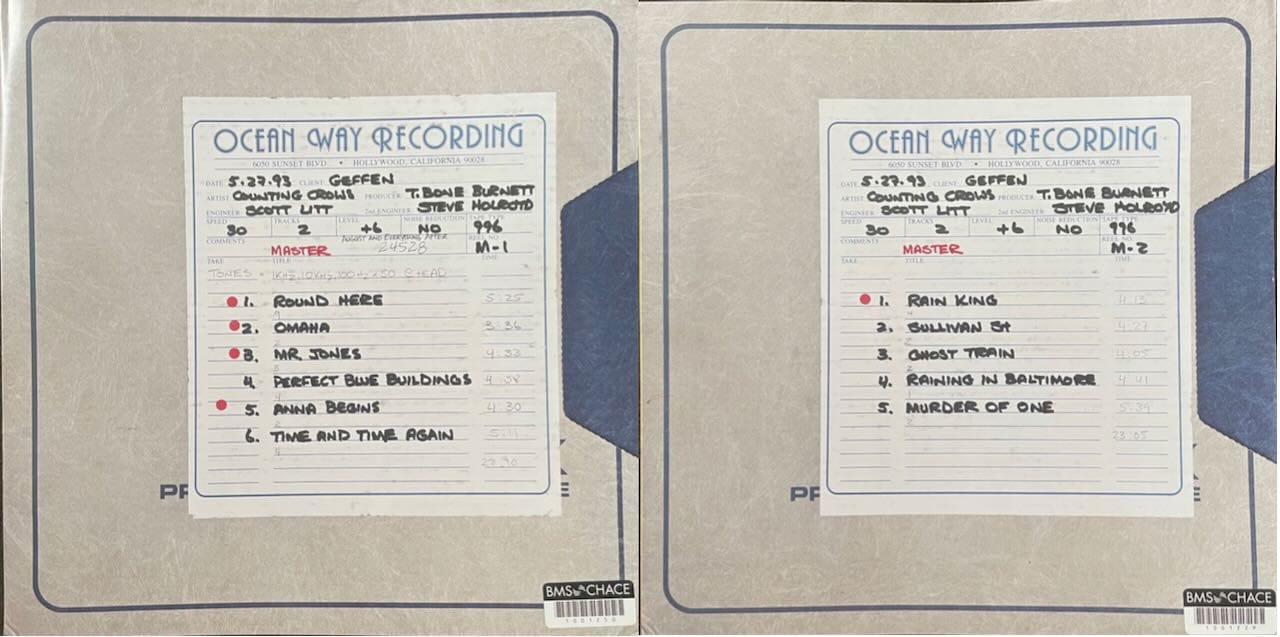
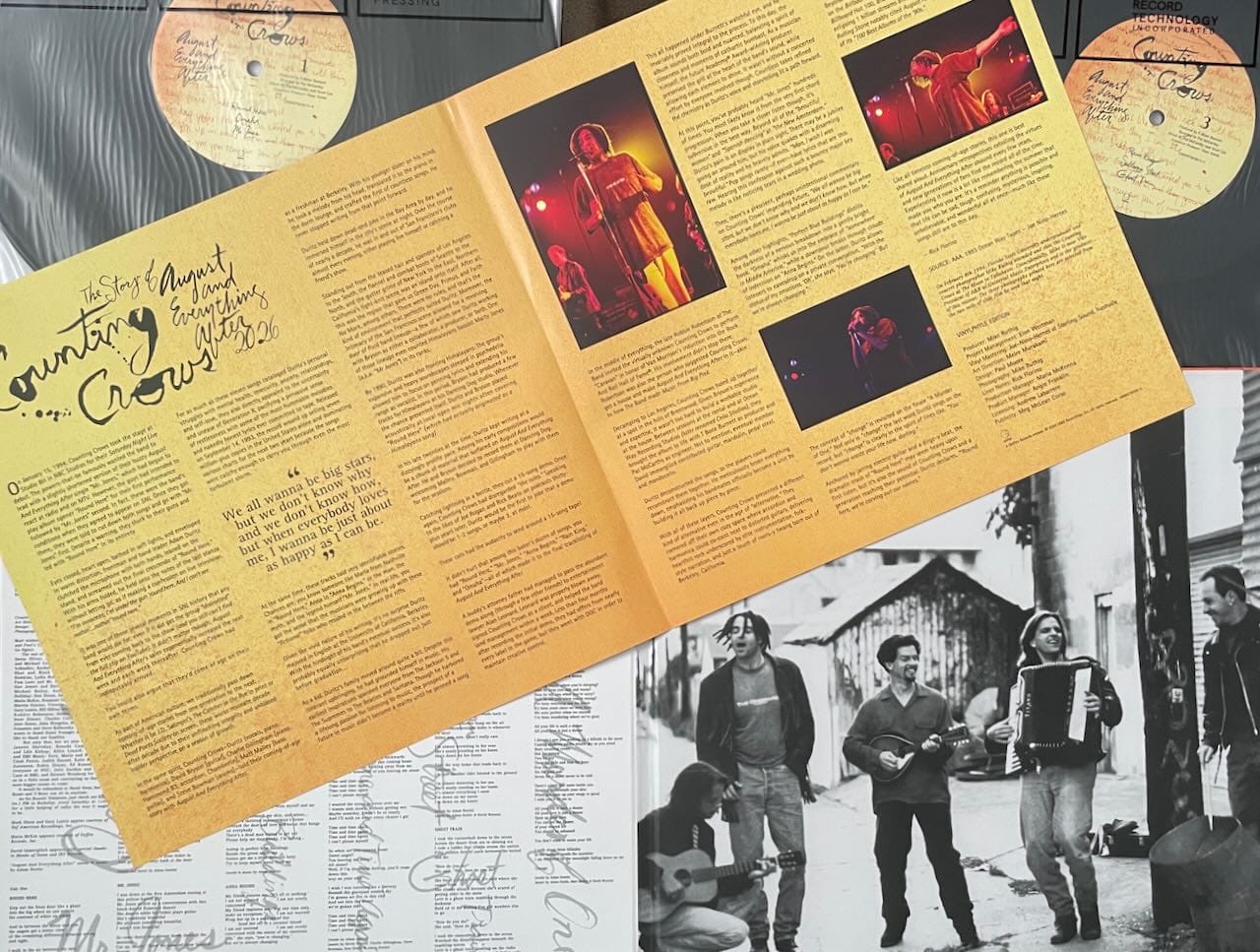
The album has previously been reissued as a 45 RPM 2-LP set by Acoustic Sounds, cut by Ryan K. Smith at Sterling Sound. Here, it plays at 33 RPM, also as a 2-LP set across four short sides, cut by Smith’s co-worker at Sterling, Joe Nino-Hernes. The pressing, done at RTI, was exemplary in my case, with not-quite-silent backgrounds and maybe a single two-rotation tick during “Sullivan Street.” The discs in my copy were flat, shiny, and superb-looking. The gatefold cover is similarly well done, with an essay by Rick Florino in the included insert that talks more about the phenomenon of the band than the actual recording process. More mythologizing, of course.
It took a few months for August and Everything After to break through, but once it did, it caught on like wildfire, surprising even the band with the outsized response. If the first album was a self-fulfilling prophecy about how Duritz wanted to be “a big, big star,” Counting Crows’ 1996 follow-up, Recovering the Satellites, was the completely predictable about-face, dissecting the miseries of fame. Perhaps that explosion of success is the modern-day takeaway from August and Everything After, which remains a very good but far from transcendent album from a band fronted by a songwriter with stars in his eyes. The California soft rock of Counting Crows might have been a pleasant change-up on rock radio in 1994, but the remarkably durable half-life of Adam Duritz’s articulate solipsism shows no sign of fading away.
Geffen/Vinylphyle 2-LP 33 RPM 180g black vinyl
• New remaster of Counting Crows’ 1993 debut album
• Jacket: “Tip-on wrapped gatefold jacket on clay-coated board” with matte finish
• Inner sleeves: RTI-branded rice-paper-style poly
• Liner notes, insert, or booklet: Four-page insert with photos of master tape boxes and essay by Rick Florino
• Source: Analog; “1993 Ocean Way Tapes”
• Vestigial mastering credit: “Stephen Marcussen at Precision Mastering, Los Angeles, CA”
• 2026 vinyl mastering credit: “Joe-Nino-Hernes [sic] at Sterling Sound, Nashville,” TN
• Lacquers cut by: Joe Nino-Hernes at Sterling Sound, Nashville, TN; “JN-H” in the deadwax
• Pressed at: Record Technology, Inc. (RTI), Camarillo, CA
• Vinyl pressing quality (visual): A
• Vinyl pressing quality (audio): A
• Additional notes: Comes in a reusable perforated poly outer bag with wraparound obi. Limited edition per obi.
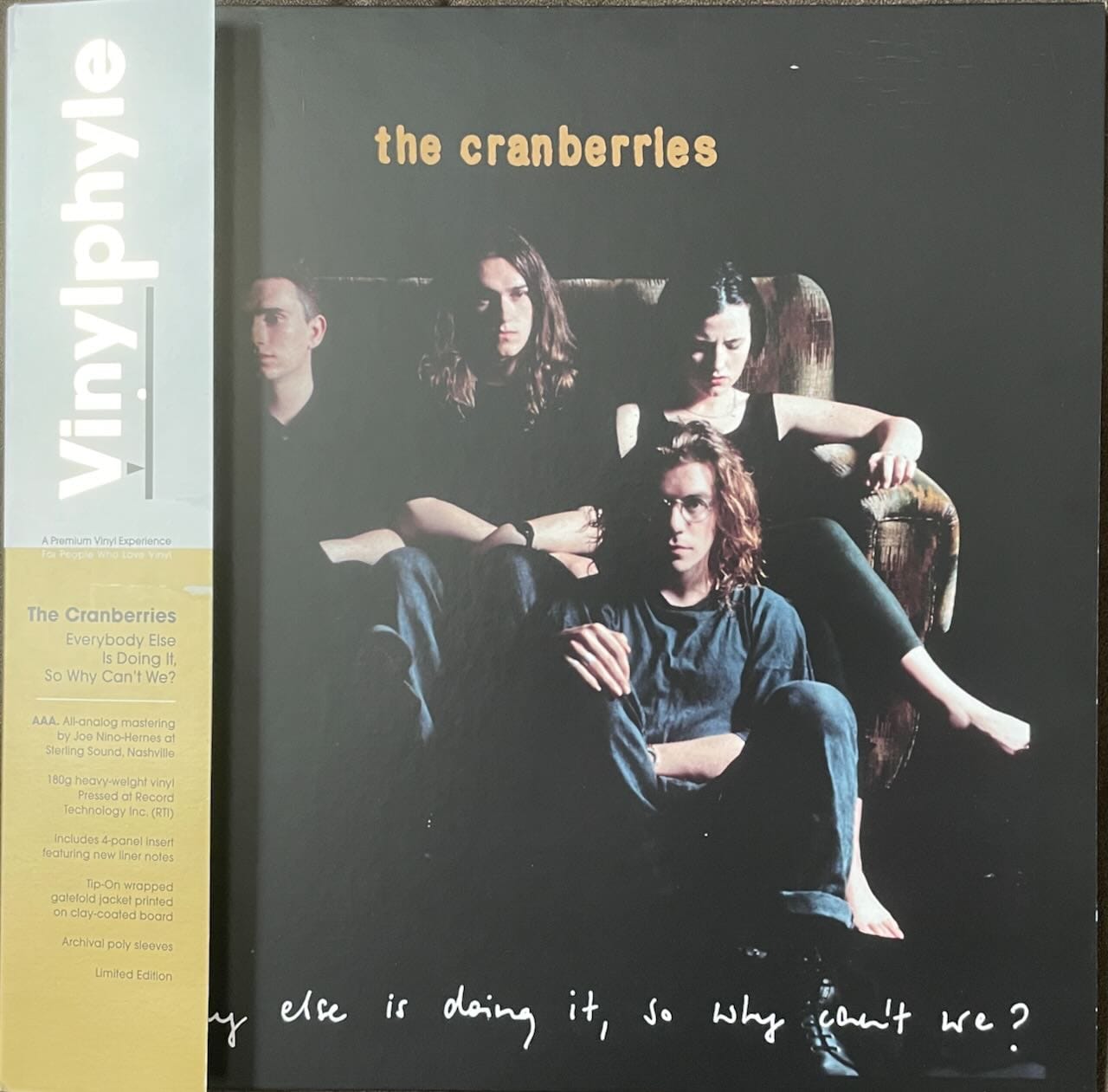
The Cranberries: Everybody Else Is Doing It, So Why Can’t We?
Another hugely successful 1993 debut album came from Limerick, Ireland, from a quartet barely out of their teens. (Bassist Mike Hogan was still in his teens, not turning 20 until after the LP’s release.) Like August and Everything After, the Cranberries’ Everybody Else Is Doing It, So Why Can’t We? was a surprise multi-platinum mega-smash built from earnest, sincere material that was frequently subdued or melancholic. And like Counting Crows, the Cranberries were fronted by a singer whose quirky but undeniably compelling vocal style became the band’s sonic signature.
Dolores O’Riordan’s voice was quintessentially Irish, flavored with lachrymose sweetness and capable of trills and yodels that sounded like they were blown in by the winds of time. She could resemble a precociously wise child or an eons-old banshee signaling doom for us all, oftentimes within the same song. Her band members—which included Hogan’s older brother Noel on guitar and co-writing the songs with O’Riordan, and Fergal Lawler on drums—delivered straightforward, early-’90s alternative rock shot through with flecks of Irish folk, dream pop, and Smiths-esque guitar jangle. The band had some heavier firepower up their sleeves, as could be heard on “Not Sorry” and “How,” but it wasn’t until their second album, 1994’s No Time to Argue, that they would fully unveil their louder, crunchier side. On Everybody Else Is Doing It, the textures remain gothic and gossamer, like the placid surface of a lake concealing darker depths beneath.
The Smiths echoes were deliberate, as Noel was a huge fan and specifically requested from Island Records that Smiths producer Stephen Street be enlisted to produce the debut, following a failed session with the band’s former manager and producer, Pearse Gilmore. Street proved to be a perfect fit, and the album is dominated by its two enormous hit singles, “Linger” and “Dreams,” which are still omnipresent on ’90s playlists today. The former is a string-laden ballad bursting with heartsick longing and teenage angst, while the latter is an exquisite dream-pop gallop through a verdant, primeval forest of swooning romanticism. The other tracks are a bit more workaday, but “Pretty,” “Not Sorry,” and “How” conjure up some compelling drama of their own. The songs are lush-sounding and sincere, arresting in their uncomplicated simplicity and callow youthfulness.
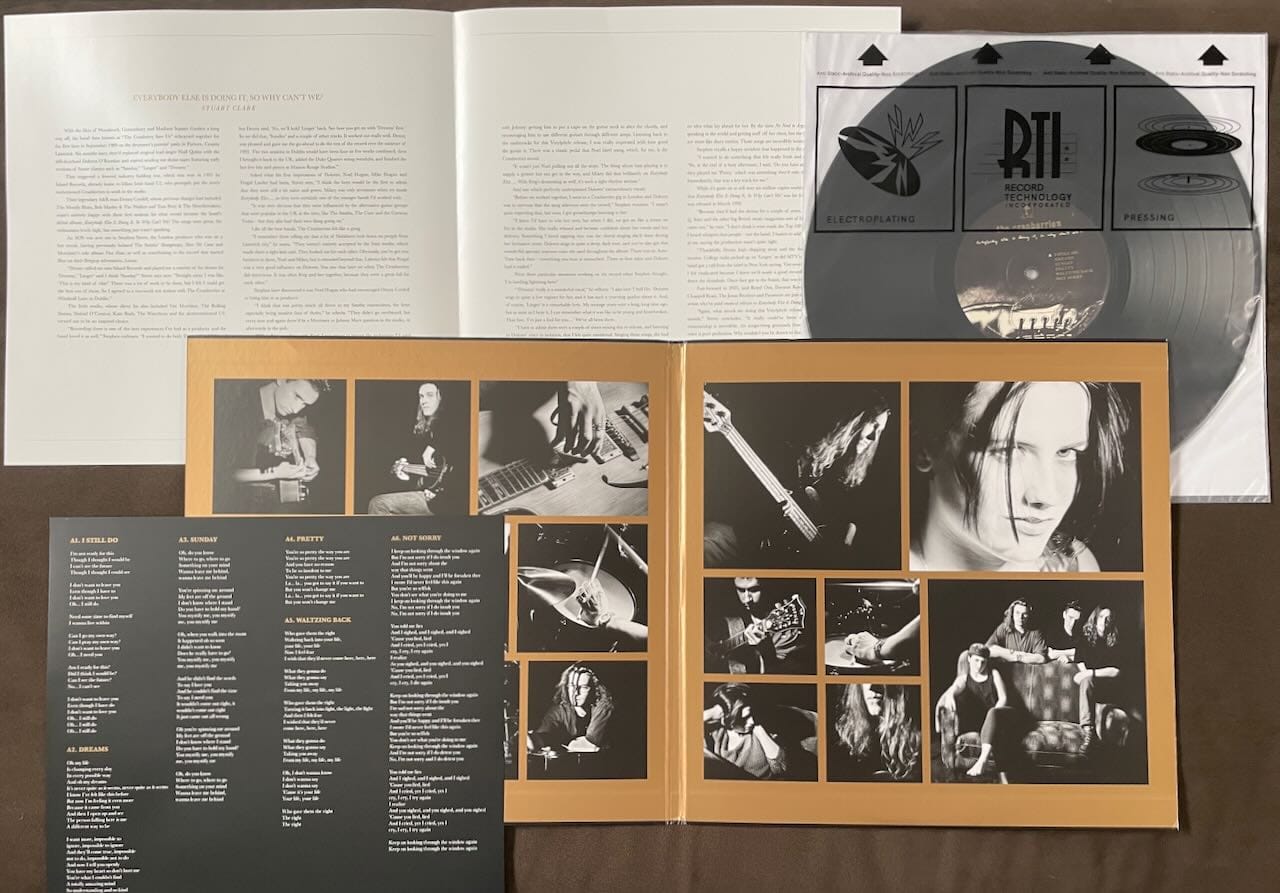
The Vinylphyle pressing of Everybody Else is remarkable. The somewhat watery production is given heft and power via Joe Nino-Hernes’s mastering, with the sonic image in ideal focus and the bass and treble expanded to just-right limits and never overcooked. Noel Hogan’s guitars sparkle and shimmer like light on the surface of water, and O’Riordan’s vocal dexterity can be fully appreciated, via her strong lead vocals or the delicate ornamentation she creates within her background overdubs. I compared this to a 1993 CD and while the sonic signature was nearly identical (unlike the Counting Crows CD), the vinyl version simply had more weight and potency, making for a much more involving and affecting listen. The glasslike sheen of the CD mastering is removed, allowing for more temperature and texture.
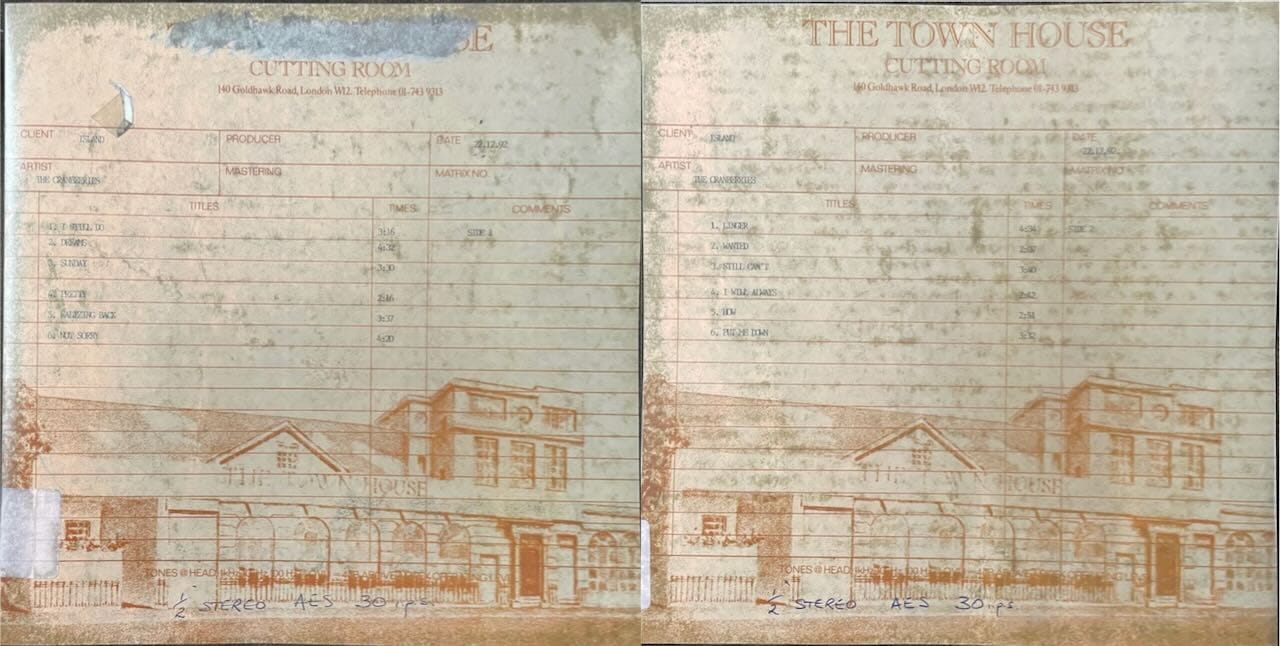
The liner notes are written by Stuart Clark and include quotes from Street, who at times seems to be referring to a 3-LP deluxe version of the album that was released at the same time as the Vinylphyle, including bonus tracks and a newly done remix. A standalone 1-LP version of just the album, with Abbey Road mastering supervised by Noel Hogan, also hit the market at the same time. Those editions were geared for the UK/European market and cut from digital, while the Vinylphyle is sourced from “1993 Assembled Mixdown Tapes,” according to the liner notes; however, the online purchase page rephrases it slightly: “1993 Assembled Master Reel.” There is also an erroneous credit in the enclosed lyrics sheet for a 2018 remaster by Miles Showell at Abbey Road, which I assume is a copy-and-paste leftover from a previous edition. Photos of the two master reels (Side 1 and Side 2) from The Town House cutting room in London are included, and I presume these are the reels that Nino-Hernes was provided to cut the disc. The album was not mixed at the Town House—it was mixed at Maison Rouge in London, from multitracks chiefly recorded at Windmill Studios in Dublin—but presumably was originally mastered there. Fascinatingly, the original 1993 US CD does not have a mastering credit.
The Cranberries’ already mournful sound acquired a new layer of sorrow with the early death of Dolores O’Riordan in 2018 at age 46. On this album she was scarcely 20, but her first songs are filled with astonishing emotional complexity, coupled with a quality of innocence and self-ownership that would be threatened by the Cranberries’ almost unimaginable success. After the release of Everybody Else Is Doing It, So Why Can’t We?, their music would never quite have that level of charming naïveté and guilelessness. This Vinylphyle edition is more heart-pumping and full of ardor than I’ve ever heard the album, forcing me to reevaluate it from the promising but slight affair I’d previously considered it (albeit with two inescapable hit singles on it). On their first full-length, the Cranberries were an incredibly young but determined group making music without irony, attitude, or arrogance. It’s a startlingly fresh thing to hear.
Island/Vinylphyle 1-LP 33 RPM 180g black vinyl
• New remaster of the Cranberries’ 1993 debut album
• Jacket: “Tip-on wrapped gatefold jacket on clay-coated board” with matte finish
• Inner sleeve: RTI-branded rice-paper-style poly
• Liner notes, insert, or booklet: Four-page insert with photos of master tape boxes and essay by Stuart Clark; a second double-sided insert includes lyrics and brief credits
• Source: Analog; “1993 Assembled Mixdown Tapes”
Vestigial mastering credit: “2018 remaster by Miles Showell at Abbey Road Studios”
• 2026 vinyl mastering credit: “Joe-Nino-Hernes [sic] at Sterling Sound, Nashville,” TN
• Lacquers cut by: Joe Nino-Hernes at Sterling Sound, Nashville, TN; “JN-H” in the deadwax
• Pressed at: Record Technology, Inc. (RTI), Camarillo, CA
• Vinyl pressing quality (visual): A
• Vinyl pressing quality (audio): A- (some minor rustling noise at the end of Side 1)
Additional notes: Comes in a reusable perforated poly outer bag with wraparound obi. Limited edition per obi.
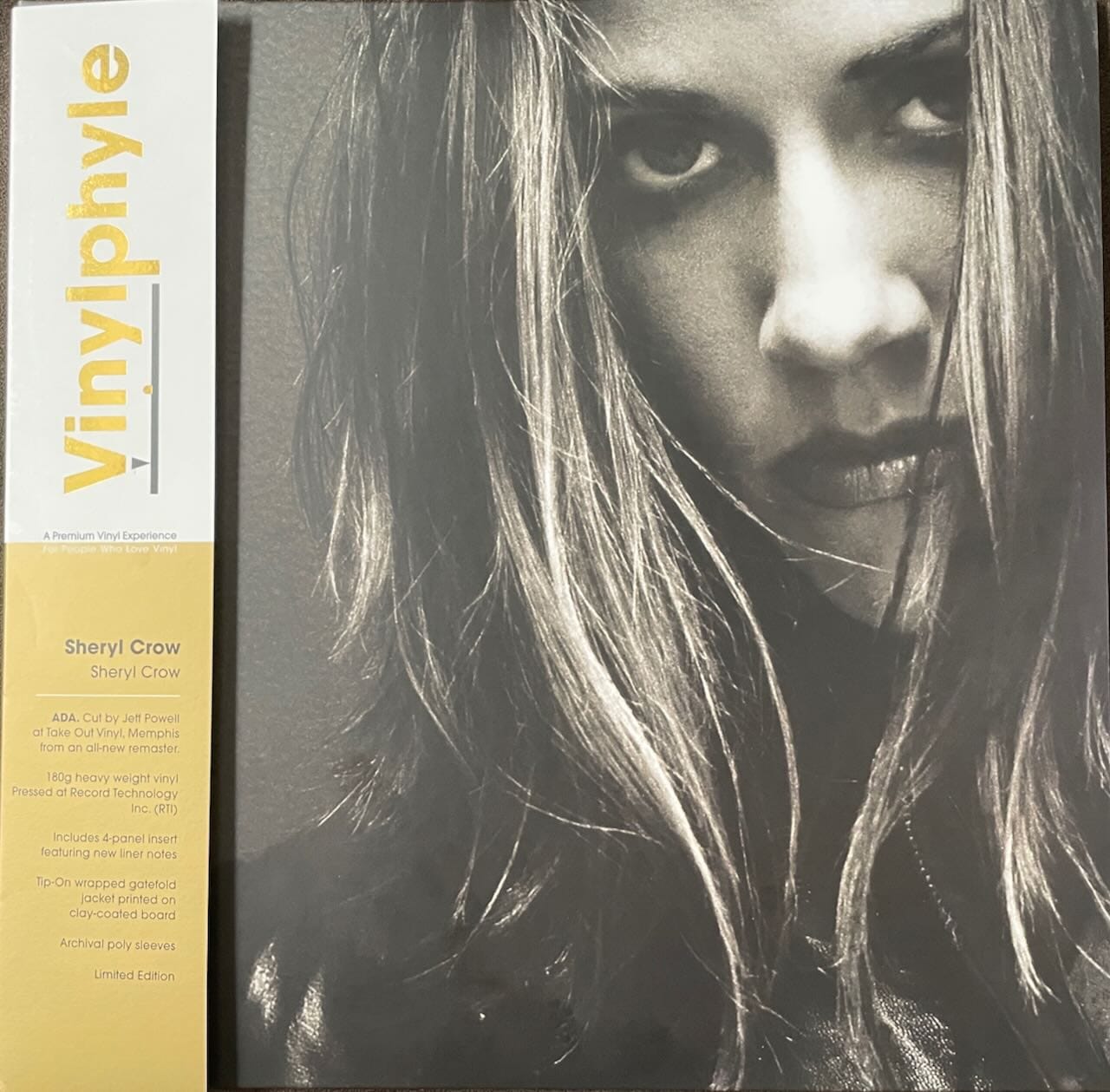
Sheryl Crow: Sheryl Crow
As I mentioned up top, this is the first time Sheryl Crow’s second album has ever been released on vinyl. This is surprising, as Crow was a huge star in the 1990s, and while her profile is not what it once was, I don’t think anybody would consider her music irrelevant these days. She was inducted into the Rock & Roll Hall of Fame in 2023, and earlier this week she was honored by the BMI performance rights cartel with a songwriting award, with Olivia Rodrigo—a longtime Crow fan and associate—performing “Strong Enough” at the intimate ceremony. Stevie Nicks has enjoyed a revival over the past few years, as has Sarah McLachlan; perhaps the time is ripe for a Crow renaissance, or perhaps it’s already begun.
Despite never having been on vinyl before, 1996’s self-titled Sheryl Crow sold millions and won Grammys, but more than that, it’s always been a well-regarded and wholly enjoyable album, straddling a very accessible blend of pop and rock with a little spark of blues and a hint of rootsy country. Recorded in New Orleans, it was produced by Crow herself when Bill Bottrell, the producer of her 1993 debut album Tuesday Night Music Club, ducked out of the project at the last minute. In fact, there was quite a bit of bad blood between Crow and several of her Tuesday Night Music Club collaborators, who felt that the first album was the product of a collective of musicians and grew resentful of Crow’s skyrocketing success as a solo star.
So titling her second album Sheryl Crow was not an accident—it was a statement that made it crystal-clear that Crow was acting entirely under her own authority. She enlisted Jeff Trott to co-write some songs and play guitar on the album, and Tuesday Night drummer Bryan MacLeod offered several drum loops; Crow’s other close collaborator was Kingsway Studios engineer Trina Shoemaker, who drew out wonderfully nocturnal sounds from the performances. Crow played bass, keys, and acoustic guitar, and a huge array of session aces and guest performers rounded out the cast.
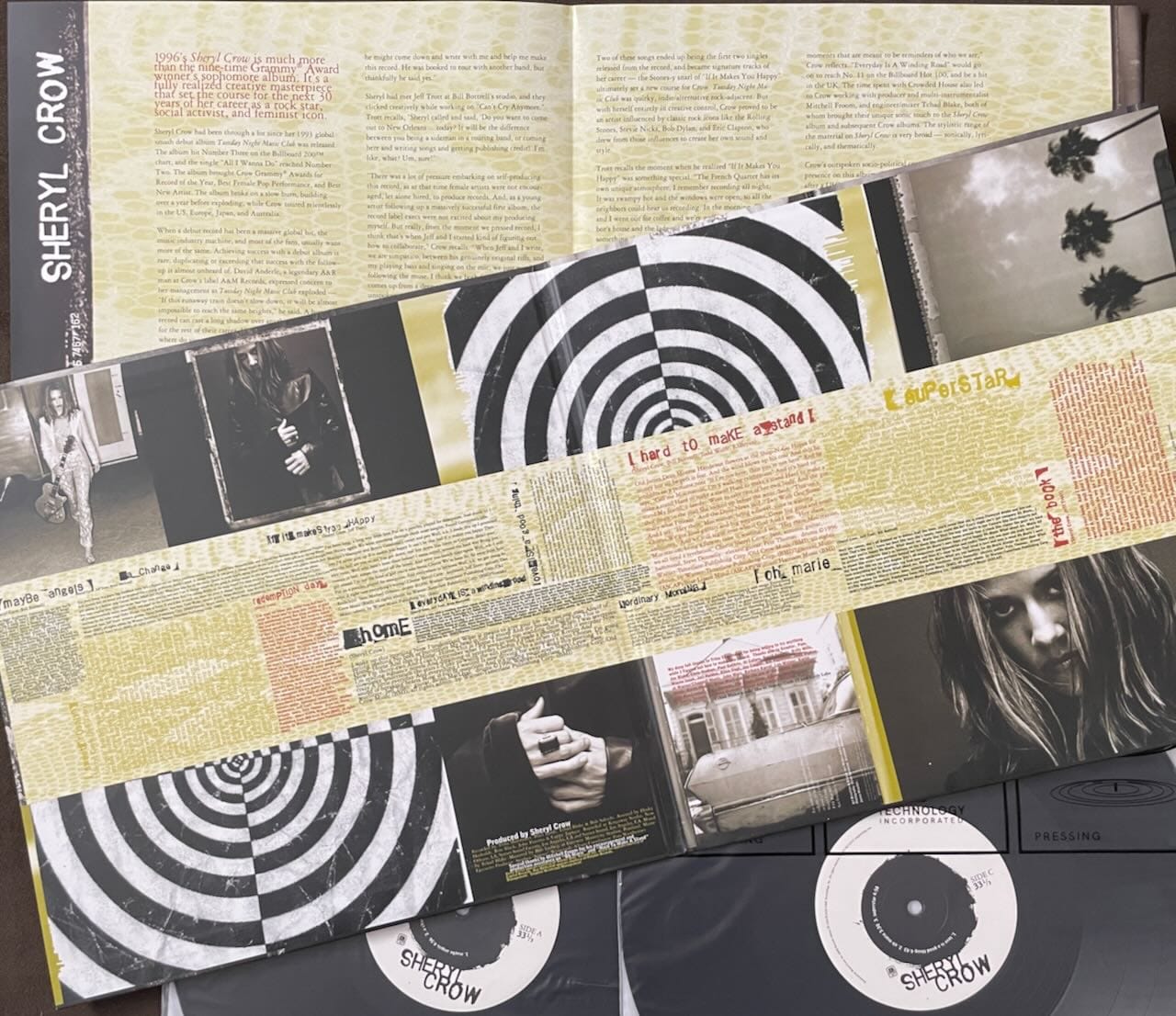
“If It Makes You Happy” is the lingering masterpiece here, with a trudging, open-tuned guitar riff that sips heavily from the anointed chalice of Keith Richards. Equal parts swagger, stomp, and twang, it evokes devil-may-care elation with an unrushed pace and strummy insouciance. The chorus, however, is what makes it a 10-pin strike. Crow leaps into the upper range of her voice, shouting in key and stretching out lines like taffy. It’s the type of song that could sound great angled in any genre direction—folk, country, punk, pop—but landed on exactly the right runway of crunchily easygoing roots-rock. It’s a song that sounded pretty terrific in 1996; it sounds even better three decades later.
The rest of the album is nearly as good; “Everyday [sic] Is a Winding Road” was another big hit, an upbeat lark accented with slide guitar and hand drum, and “Love Is a Good Thing” got the album banned from Walmart with the line “Watch our children while they kill each other with a gun they bought at Walmart discount stores.” At 13 songs, there are perhaps two or three too many tracks here—the stretch that includes “Oh Marie,” “Superstar,” and “The Book” feels like a downshift from the album’s earlier heights—and the album perhaps could have been tightened to just 10 absolutely killer picks, but again, this was the CD era. As such, Sheryl Crow contains enough moods and musical styles to actually be pretty well suited to the format of a sprawling double album, and the Vinylphyle version adds a bonus track in the form of the calico-print country tune “Sad Sad World,” which is more than good enough to have been part of the original tracklist.
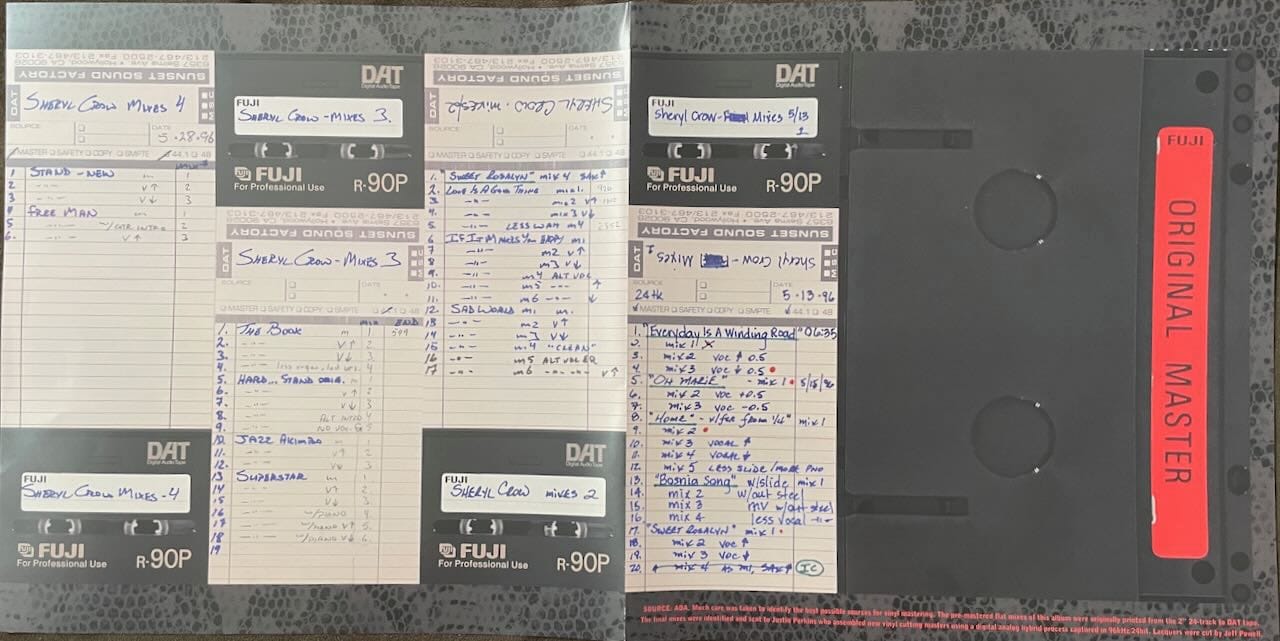
The source of the album is a little convoluted. On the insert, it reads: “Much care was taken to identify the best possible sources for vinyl mastering. The pre-mastered flat mixes of this album were originally printed from the 2” 24-track to DAT tape. The final mixes were identified and sent to Justin Perkins who assembled new vinyl cutting masters using a digital/analog hybrid process captured in 96kHz/24bit.” I’m not sure what the “digital/analog hybrid process” part means—if Perkins made analog reels from the DAT masters, I wonder why they were then converted back to digital for lacquer cutting. Or perhaps it doesn’t really mean anything at all. I’m also confused by where it says, “The… flat mixes… were originally printed from the 2” 24-track to DAT tape.” Were the album’s stereo mixes mixed down onto a 24-track tape ordinarily used for multitracking, rather than mixed down onto a two-track stereo reel? Perhaps putting a two-channel stereo mix onto a multitrack tape (and leaving the other 22 tracks blank) is standard operating procedure? If so, then were those 24-track analog tapes then unavailable for sourcing for this Vinylphyle? (Did they burn in the Universal fire?) Or are they saying the multitracks, made on 24-track tape, were then mixed down for stereo directly onto DAT? If that’s true, then the SPARS code on the original CD is incorrect; it says AAD when it should be ADD.
The original mastering credit for the 1996 release lingers inside the gatefold: It’s Bob Ludwig, who was operating out of his Portland, Maine, studio but this time. However, since they went back to the pre-mastered flat mixes for this Vinylphyle edition, none of Ludwig’s work has been retained here. One more thought: The images of the DAT tapes are lousy with all kinds of alternate mixes. The insert note says “The final mixes were identified,” which means there is potential room for error. Perhaps there’s a small chance that a different, previously unreleased mix for one or more of the tracks slipped through onto this new edition. It seems like something like that always happens with these kinds of reissues. I will let a keener Crow fan than myself do the detective work on that one.
For an album that was never on vinyl until now, Sheryl Crow sounds like it was born to be on wax. Justin Perkins at Mystery Room Mastering doesn’t get a full mastering credit here, but I think he must have done significant work to make the album sound as cohesive as it does and extracted more detail from those 16/44.1 DAT mixdowns. And Jeff Powell cut the lacquer, so between the two of them, they’ve made a muscular, warm, and full-bodied record out of the existing masters. The album is a hybrid of classic-rock tropes and ’90s production tricks like drum loops and off-kilter percussion; it all sounds appropriately big but never overamped or disproportionate. It’s fun to pick out the little details, like Steve Berlin’s sax on “Sweet Rosalyn” or the distant thunder-rumble of percussion in “Redemption Day.”
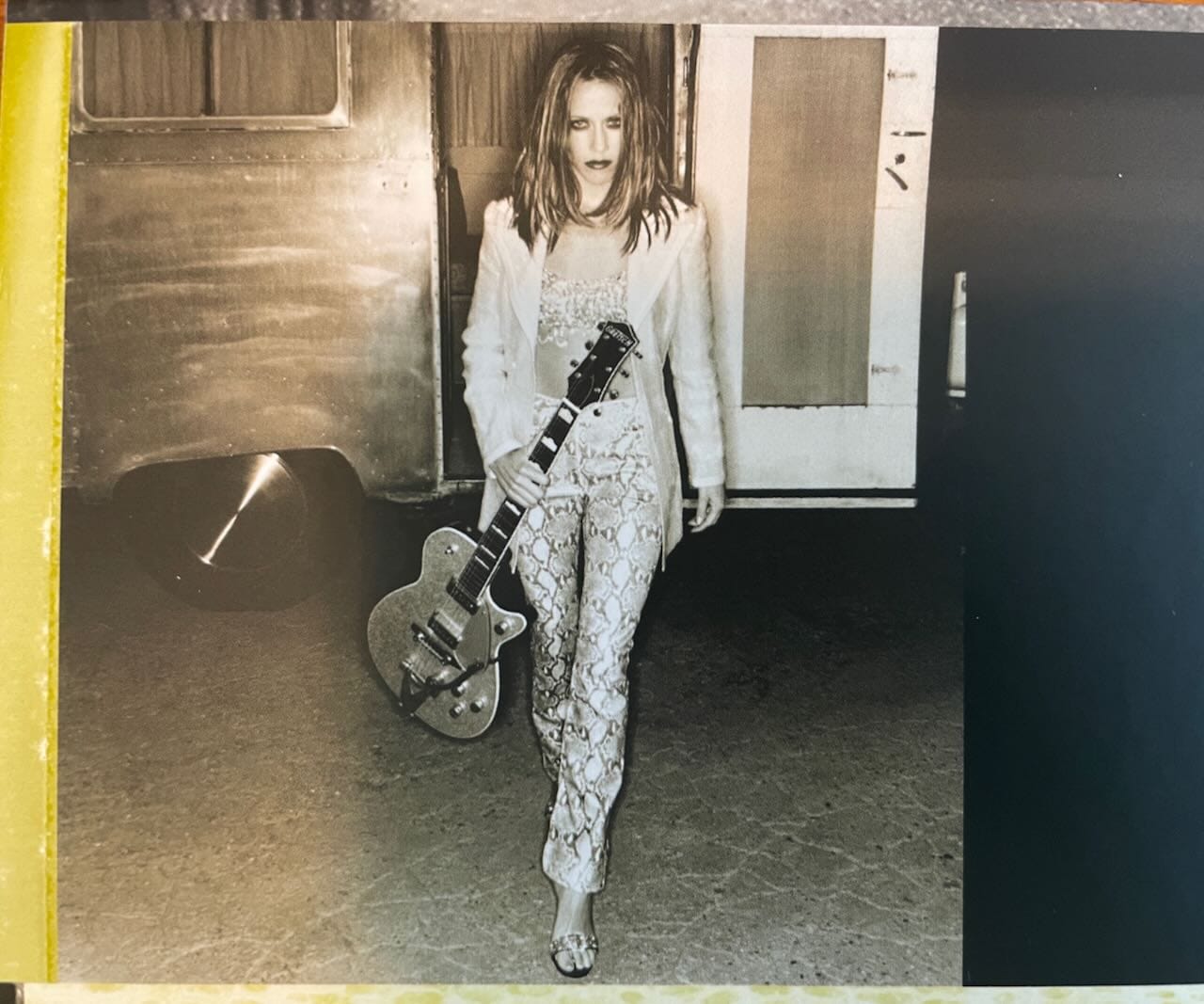
In direct comparison to the 1996 CD, it is immediately noticeable that the Vinylphyle has more shape and weight to the individual instruments, and to use a visual metaphor, it relights the elements and sonic surfaces within the mix to give everything more pop, glow, and shade. There’s also a slightly coarser texture that tampers down the album’s ’90s pop-radio flavor in favor of a more ’70s classic-rock one. Guitar notes have more snap and twang, and Crow’s Wurlitzer electric piano has more shimmer to it. The CD is awfully good-sounding, and on a few songs, the bass extension is stronger than on the Vinylphyle, but generally speaking, the Vinylphyle is a subtle but undeniable step better.
This is an album I always retained a reasonably fond memory of, although it never became an essential part of my own biographical discography. I was happy to discover, then, that Sheryl Crow is much better than I remembered, with nine or 10 superbly written and executed songs and the rest more than pleasant enough to make it worth flipping the side three times. Crow had a lot to prove with this second outing, with her first album achieving an irreplicable level of success and the bottom falling out with her original co-conspirators. This album proves she was more than capable of meeting the challenge. For me, this was the most enjoyable and relistenable Vinylphyle reissue in this ’90s batch—for fans of the album who have a turntable in the house, it’s positively essential.
A&M/Vinylphyle 2-LP 33 RPM 180g black vinyl
• New remaster of Sheryl Crow’s 1996 album
• Jacket: “Tip-on wrapped gatefold jacket on clay-coated board” with matte finish
• Inner sleeves: RTI-branded rice-paper-style poly
• Liner notes, insert, or booklet: Four-page insert with photos of DAT masters and essay by Jim McDermott
• Source: Digital; new assembly of DAT transfers captured in 96/24
• Vestigial mastering credit: “Mastered by Bob Ludwig at Gateway Mastering Studios, Portland, Maine”
• Assembly of new cutting masters: Justin Perkins at Mystery Room Mastering, Madison, WI
• 2026 vinyl mastering credit: “Jeff Powell, Take Out Vinyl, Memphis,” TN
Lacquers cut by: Jeff Powell at Take Out Vinyl, Memphis, TN; “J POWELL” in the deadwax
• Pressed at: Record Technology, Inc. (RTI), Camarillo, CA
• Vinyl pressing quality (visual): A
• Vinyl pressing quality (audio): A
• Additional notes: Comes in a reusable perforated poly outer bag with wraparound obi. Limited edition per obi.
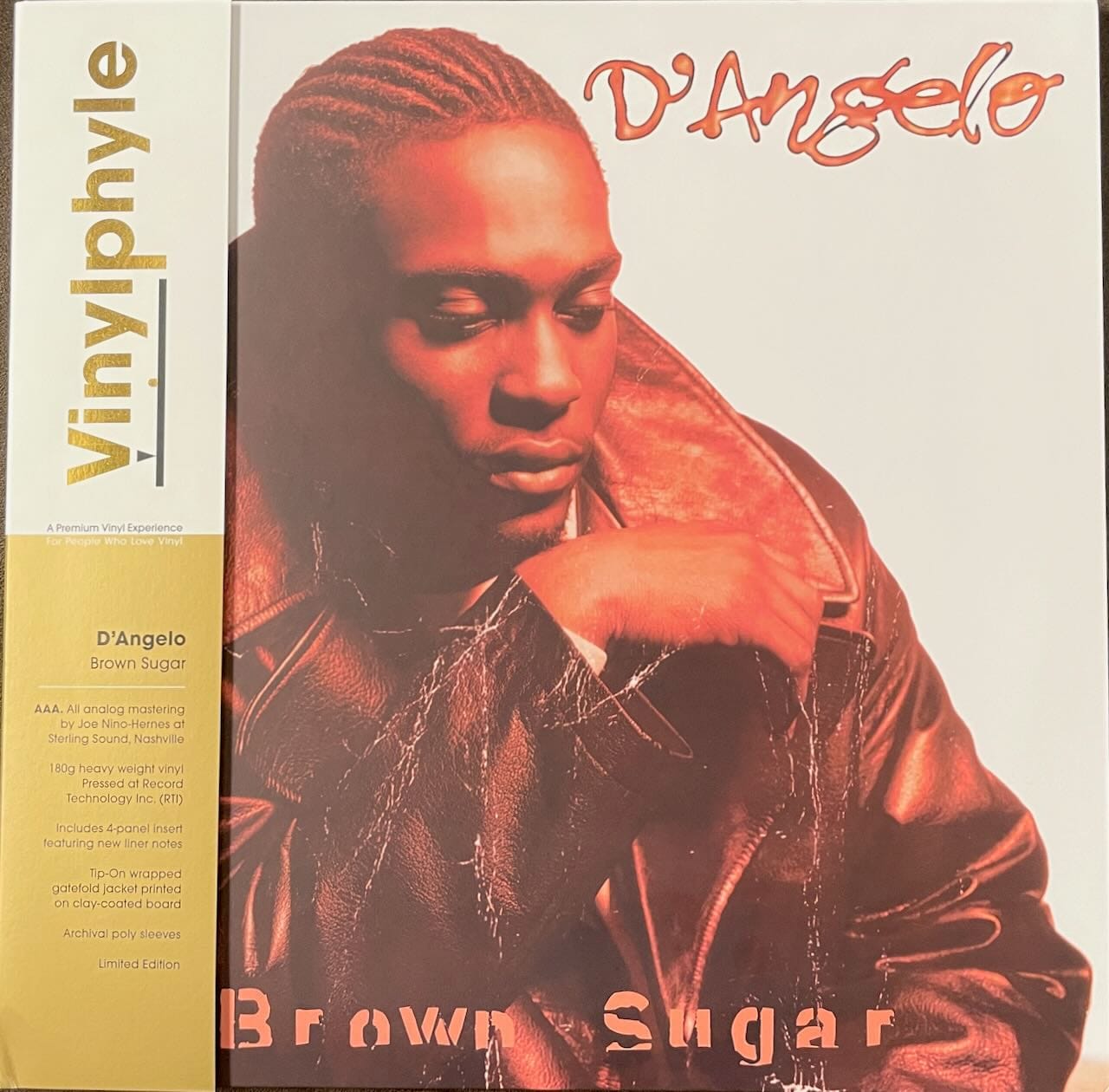
D’Angelo: Brown Sugar
D’Angelo’s debut is perfectly named. Brown Sugar is sticky, sweet, suggestive of both sex and drugs, and decidedly not-white. The languorous, luxurious 1995 collection of R&B slow jams announced D’Angelo—born Michael Eugene Archer—to the world as a complete auteur: performer, songwriter, arranger, and producer, capable of stacking vocals that could sound like a gospel choir or a trio of session ladies, and prone to building bedroom rhapsodies out of simple synth patches and programmed beats. This is music full of virility and assertiveness, with none of the attendant aggression or chauvinism. The keyboard and guitar notes are rounded like soap bubbles, and the beats are gently eased along by cross-sticks and fingersnaps.
Brown Sugar came at an auspicious time in the R&B timeline, marking a bold new step away from the new jack swing that had dominated the early ’90s. Some of the newly incorporated musical elements, such as the omnipresent Fender Rhodes electric piano, were meant to evoke the organic sound of ’70s soul, while others were reflective of the persistent, hypnotic rhythms of contemporary hip-hop. On certain tracks, the deliberate swerve away from new jack swing brings Brown Sugar a little too close to smooth jazz for comfort. But elsewhere, there’s a sense of new ground being charted, following a path from ’70s superstars like Steve Wonder and Marvin Gaye, to the sexually charged virtuosity of ’80s Prince, all the way up to the new beats, cadences, and sonic palettes that were exploding out of the East Coast and West Coast hip-hop scenes in the ’90s.
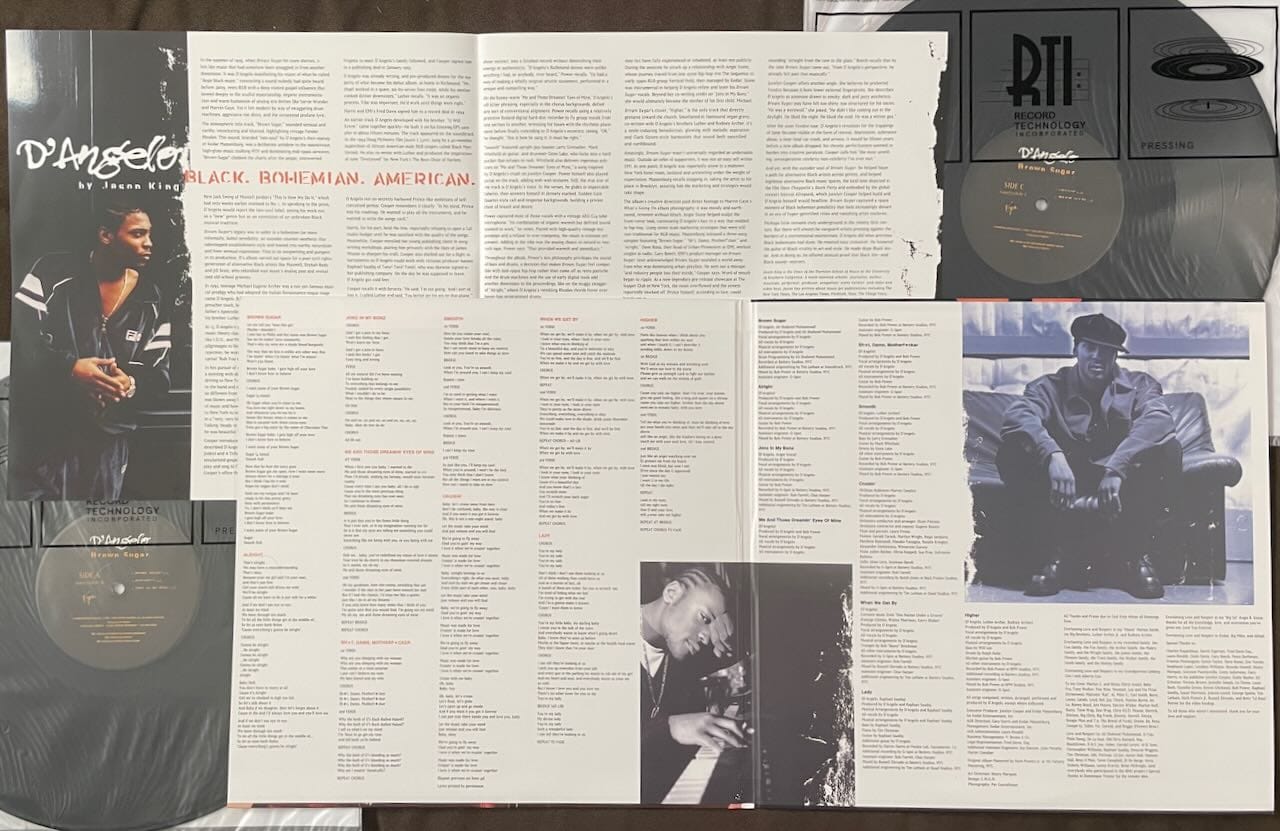
While D’Angelo performed many of the tracks himself, there were outside contributors, like A Tribe Called Quest’s Ali Shaheed Muhammad and Tony! Toni! Toné!’s Raphael Saadiq. But D’Angelo dominates, to both exhilarating effect and occasional monotony. Barely 20 years old when the bulk of the album was recorded, his songwriting chops are a bit underdeveloped in places, where he’s content to take a groove and ornament it with his vocal prowess but fails to provide much in the way of melodic development. His cover of Smokey Robinson’s “Cruisin’” puts this in clear relief, with its textbook pop melody rising and falling like a rollercoaster providing a marked contrast from a D’Angelo-penned song like “Jonz in My Bonz,” which rides the barest wisp of a hook for nearly six minutes. Other limitations include the chintzy digital timbres on tracks like “When We Get By,” which feel at complete odds with the human touch that neo-soul would eventually come to represent.
D’Angelo would mature, of course, on subsequent albums, and Brown Sugar songs like “Lady” and the title track are evidence of a volcanic talent about to go off. This seismographic activity can also be heard in the pure gospel of “Higher,” with D’Angelo’s armada of voices and church-like organ floating on top of a simple backing trio.
While not all of the material is to my liking, the Vinylphyle release of Brown Sugar is positively stunning. Each of D’Angelo’s many voices is perfectly perceptible, and the rounded tones of the pianos and guitars are funky and full. But the bass—much of it emitting from synthesizers—is what’s truly remarkable here. It is articulate, deep, and full of rhythm; there is no smoosh or blur to its precision and impact, even as it vibrates the floorboards. “Jonz in My Bonz” and “Higher,” in particular, have remarkable bass extension that might well provide reference points for your system.
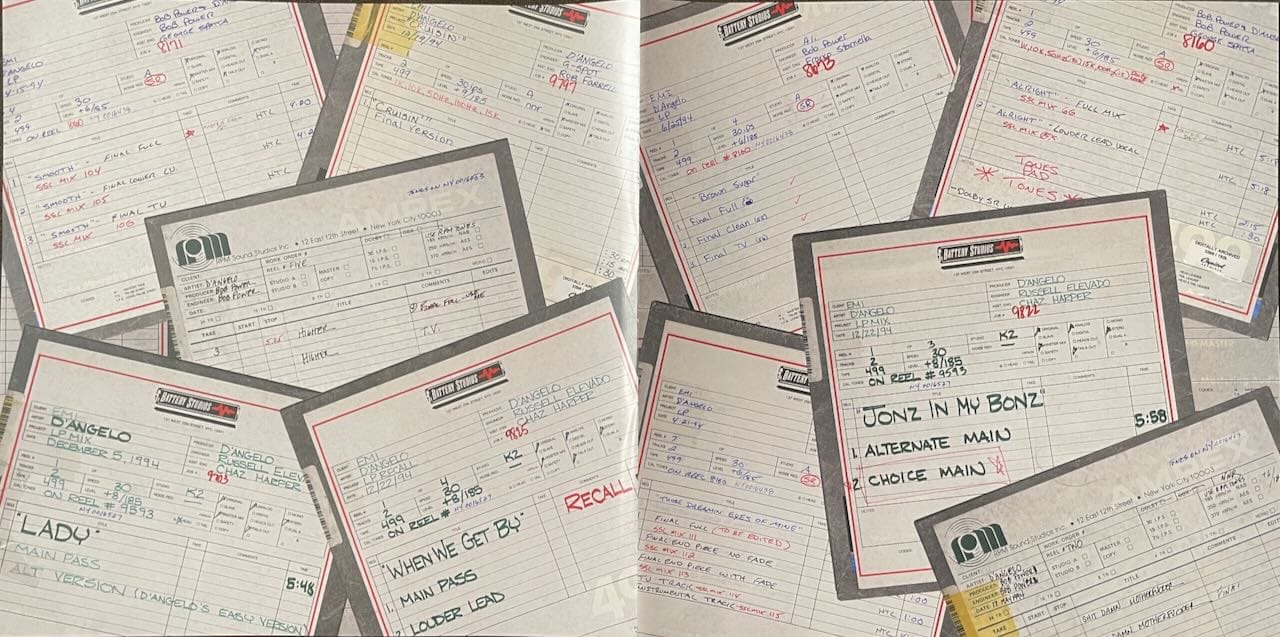
Brown Sugar has been released on vinyl a few times over the years, but this Vinylphyle edition marks the only time it has been cut from analog tape. Per the note on the insert: “Each song on Brown Sugar has its own analog mix reel and the album was digitally assembled for final CD and vinyl mastering for its 1995 release. For this edition, we made for each side a new all-analog machine-to-machine 1/2” 30 IPS prediction master from the individual mix reels. These new tapes were used to cut this LP.”
These new assembly analog reels, with 1:1 copies of the original mixdowns, make for an immediate and warmblooded listen. Joe Nino-Hernes has handled the vinyl mastering astonishingly well, as he has a fabulous touch with not just the intimacy of D’Angelo’s latticework of vocals but also the thick bottom end that these tracks require. The perfect pressing from RTI, with silent backgrounds and nary a click or tick, makes these tracks all the stronger. And the exceptionally detailed and insightful liner notes by Jason King provide essential context and analysis, as well as some very welcome technical info. Even if Brown Sugar isn’t my favorite album from the ’90s, this might be one of the most striking vinyl presentations I’ve ever heard of music of that decade.
Virgin/Vinylphyle 2-LP 33 RPM 180g black vinyl
• New remaster of D’Angelo’s 1995 album
• Jacket: “Tip-on wrapped gatefold jacket on clay-coated board” with matte finish
• Inner sleeves: RTI-branded rice-paper-style poly
• Liner notes, insert, or booklet: Four-page insert with photos of the individual track mixdown reels and an essay by Jason King
• Source: Analog; new analog assembly reels dubbed from the original analog mixdown reels
• Vestigial mastering credit: “Original album mastered by Herb Powers Jr. at Hit Factory Mastering, NYC”
• 2026 vinyl mastering credit: “Joe Nino-Hernes at Sterling Sound, Nashville,” TN
• Lacquers cut by: Joe Nino-Hernes at Sterling Sound, Nashville, TN; “JN-H” in the deadwax
• Pressed at: Record Technology, Inc. (RTI), Camarillo, CA
• Vinyl pressing quality (visual): A
• Vinyl pressing quality (audio): A (essentially flawless)
• Additional notes: Comes in a reusable perforated poly outer bag with wraparound obi. Limited edition per obi.

Genius/GZA: Liquid Swords
Two short years after the release of Wu-Tang Clan’s epoch-defining debut album, 1993’s Enter the Wu-Tang (36 Chambers), the Staten Island rap collective was already operating like a full-fledged industrial complex. Solo albums from the individual members—Raekwon, Ol’ Dirty Bastard, and Method Man—were coming fast and furious, and Wu-Tang architect/producer RZA had expanded his reach to the Gravediggaz project and other Staten Island artists.
Within this blizzard of activity, RZA and Wu-Tang rapper GZA, aka Genius, had time to put together Liquid Swords, the 1995 solo album from Genius/GZA that has since become a hip-hop classic, perhaps the most highly regarded Wu-Tang release alongside Enter the Wu-Tang, Ol’ Dirty Bastard’s Return to the 36 Chambers, and Raekwon’s Only Built 4 Cuban Linx…. The fact that those last two albums and Liquid Swords were all released within months of each other in 1995 is proof that Wu-Tang were operating at a level unmatched by any group of that era, hip-hop or otherwise. (A more obvious way to put it, perhaps, is that Wu-Tang Clan ain’t nuthing ta… well, you get the idea.)
GZA’s Liquid Swords remains a far more cohesive listen than most ’90s rap albums, with a consistency from track to track and relative restraint on interstitial skits (what is there is thematically part of the album and not just cringeworthy studio goofs). GZA, born Gary Grice, draws from his interests in chess, samurai films, and Eastern philosophy to provide rhymes of depth, complexity, and playfulness. And RZA’s production is razor-sharp, using darker beats and musically minimal samples to provide a landscape of desolation and shadow. The pair threaded audio excerpts from the 1980 film Shogun Assassin—an American reworking of the first two films in the Japanese Lone Wolf and Cub series—throughout the album, providing an overarching narrative about purpose, dedication, and ferocity amid a world teeming with endless enemies. (It also features chunks of the movie’s score, composed by Paul Revere and the Raiders frontman Mark Lindsey and W. Michael Lewis.)
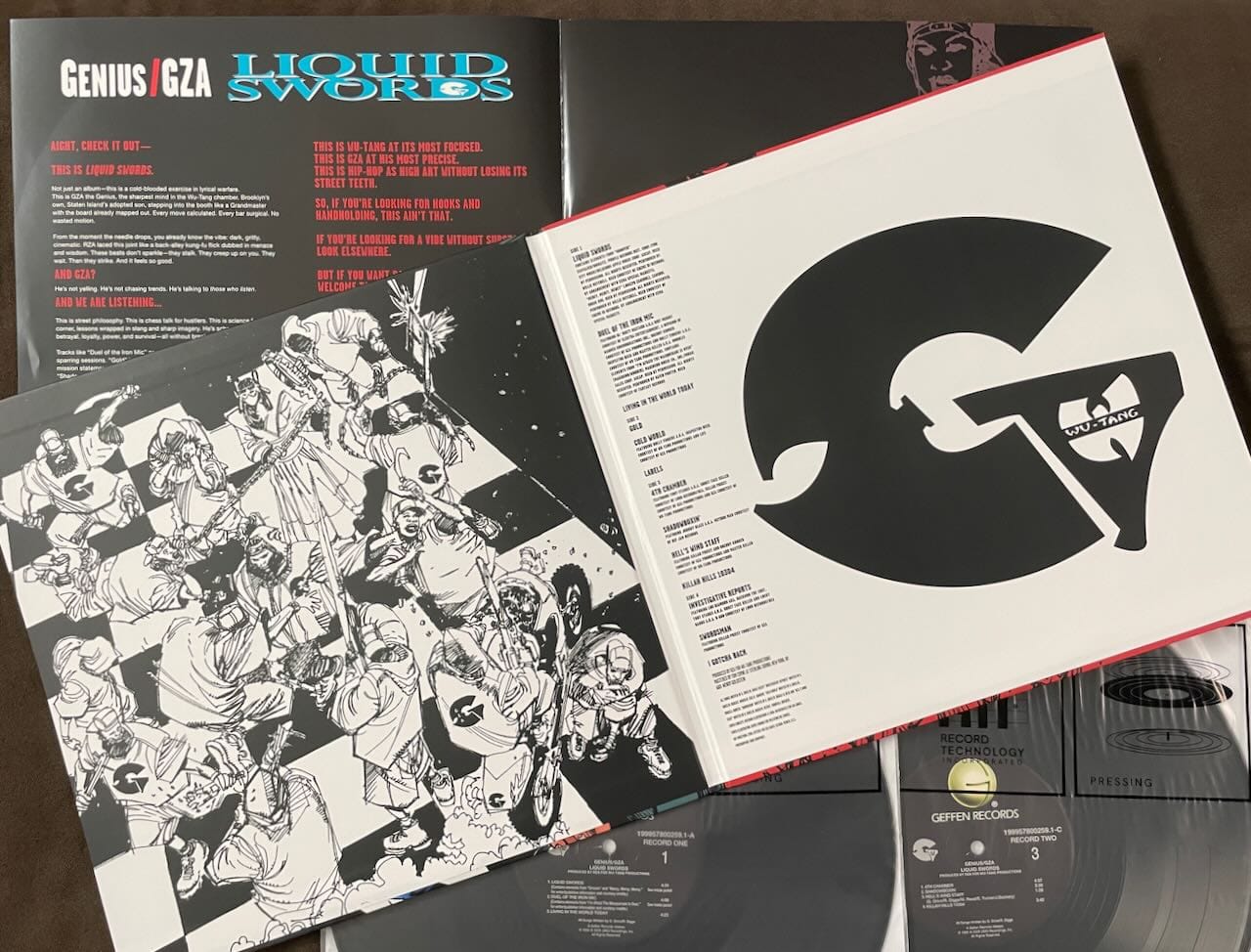
The title track likens wordplay to the blades of samurai swords, and “Duel of the Iron Mic,” which features spots by Inspectah Deck, Masta Killa, and ODB, continues the metaphor of rhyming as a means to assert dominance without actual violence. Elsewhere, “Labels” cleverly namedrops specific record labels, like Tommy Boy, Virgin, Mercury, ATCO, Jive, and others, as parasites designed to suck the blood from the artists that provide their revenue. And “Investigative Reports,” featuring Raekwon, Ghostface Killah, and U-God, is an unflinching snapshot of the urban landscape of Staten Island, with lines detailing crime, poverty, and gang activity calcified by RZA’s sample of a nightly newscast.
Despite the bleakness of the subject matter and RZA’s consciously designed grimy backdrop, Liquid Swords is an energizing and absorbing listen, as propulsive as a page-turning crime novel, albeit with immaculate verbal repartee from GZA instead of hard-boiled prose. The rhythms are slow and low, like a car creeping through a neighborhood, with primitive synth phrases repeated to add suspense to the sampled beats. The voices—GZA’s, RZA’s, and all the guest performers—are front and center, as this is an album about language and flow.
The Vinylphyle pressing spreads the 50-minute album across two LPs at 33 RPM, matching earlier vinyl editions; the bonus track “B.I.B.L.E.” that appeared on some versions is not included here. The new pressing features new mastering by Joe Nino-Hernes from the original master DAT made at Sterling Sound in New York. A note on the insert says, “While sessions were recorded to 2” 24-track tape, final mixes were printed on DAT tapes.” It adds, “Digital sampling was an integral part of producer RZA’s creative process from start to finish,” which I take to mean simply that some of the sources on the analog multitrack were of digital origin. So the chain is not all-analog, but Nino-Hernes was able to go back to the closest thing to the source: the Sterling Sound DAT master.
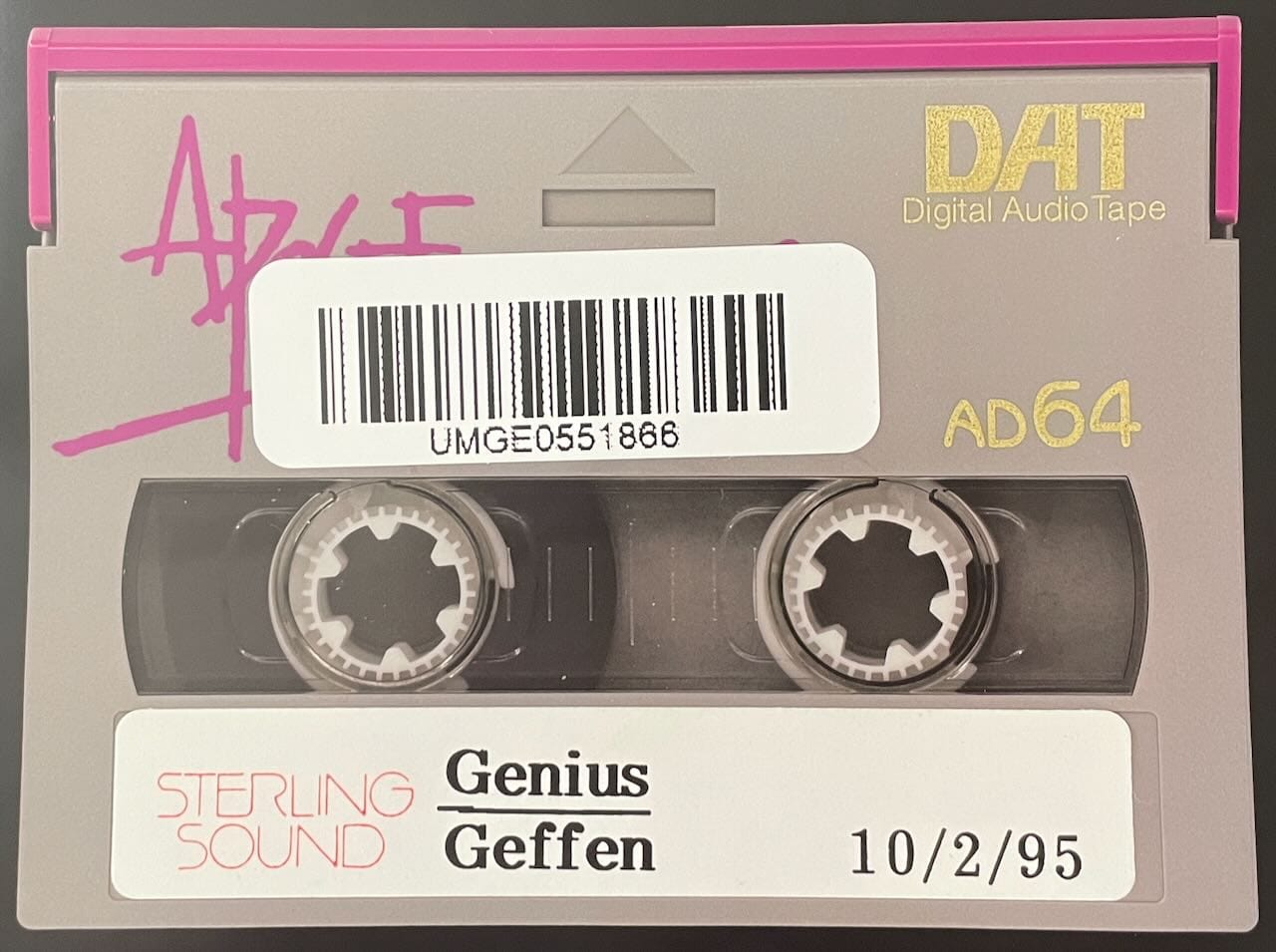
The resolution of that master is not specified, but the standard for an Apogee AD64 DAT is likely not that different from the Red Book CD standard, at 16/44.1 or possibly 16/48. It’s unclear to me whether the DAT source was what was presented to the album’s original mastering engineer, Sterling Sound’s Tom Coyne, or whether it’s the result of the mastering work he did. Regarding the insert, the liner notes take the form of a very short hype essay by former Yo! MTV Raps host Ed Lover that sadly offers nothing of substance about the album or its recording process—it’s a pretty worthless promotional blurb.
The sound is thick on the bottom and crisply articulate on the top, offering a vivid reproduction of the production’s intended forcefulness. The beats make their mark while the bass plumbs the correct depths, with the rapping front, center, and undeniably present. The mix is quite confined, occasionally close to mono, which serves to solidify the impact. But RZA’s production, though far from high fidelity, is filled with small details and quiet asides that are a pleasure to excavate on this new pressing. The silent backgrounds and flawless pressing from RTI aids this immeasurably.
Liquid Swords has not been especially difficult to find on vinyl, but this Vinylphyle pressing elevates the material with the expertise of Nino-Hernes on the cutting lathe and a very impressive pressing from RTI. More importantly, it diversifies Vinylphyle’s portfolio to include another hip-hop classic (following the Gang Starr reissue from earlier this year). I don’t think I’d be the only one to argue that Liquid Swords is on a very short list of essential ’90s hip-hop albums, so if that’s an area of music you want represented in your collection and you don’t already have a copy, the new Vinylphyle will more than fit the bill.
Geffen/Vinylphyle 2-LP 33 RPM 180g black vinyl
• New remaster of Genius/GZA’s 1995 solo album
• Jacket: “Tip-on wrapped gatefold jacket on clay-coated board” with matte finish
• Inner sleeves: RTI-branded rice-paper-style poly
• Liner notes, insert, or booklet: Four-page insert with photos of the DAT master tape and a short hype piece by Ed Lover
• Source: Digital; “1995 Sterling Sound Digital Master”
• 1995 mastering credit: “Mastered by Tom Coyne at Sterling Sound, New York, NY”
• 2026 vinyl mastering credit: “Joe Nino-Hernes at Sterling Sound, Nashville,” TN
• Lacquers cut by: Joe Nino-Hernes at Sterling Sound, Nashville, TN; “JN-H” in the deadwax
• Pressed at: Record Technology, Inc. (RTI), Camarillo, CA
• Vinyl pressing quality (visual): A
• Vinyl pressing quality (audio): A
• Additional notes: Comes in a reusable perforated poly outer bag with wraparound obi. Limited edition per obi.
Listening equipment:
Table: Technics SL-1200MK2
Cart: Audio-Technica VM540ML
Amp: Luxman L-509X
Speakers: ADS L980